
With this subdued forecast, India is likely to record its worst growth performance since the 1991 liberalisation. However, it is among the only two major economies, which will register a positive growth rate in 2020. The other being China, for which the IMF has projected a growth rate of 1.2 per cent.

India's services sector growth recorded another month of robust expansion in July, albeit at a slightly slower pace than in June, largely supported by robust demand conditions and investment in technology, a monthly survey said on Monday. The seasonally adjusted HSBC India Services Business Activity Index was at 60.3 in July, down only fractionally from 60.5 in June. In the Purchasing Managers' Index (PMI) parlance, a print above 50 means expansion, while a score below 50 denotes contraction.

IMF said in 2017, India is likely to grow at the rate of 7.2 per cent instead of the earlier projected 7.6 per cent.

It is all the more remarkable that this acceleration took place in a period when the dollar was mostly appreciating against other currencies. The fact that imports declined by over 7 per cent meant that the external sector contributed hugely to the acceleration in the growth rate.

'Given the 50 per cent or thereabouts increase in borrowing that has been announced, it is a reasonable estimate to say that at this time, an increase of 1.7-1.8 per cent on the 3.5 per cent budgeted fiscal deficit target is being anticipated,' Chief Economic Adviser Krishnamurthy Subramanian said on Friday.
In line with other rating agencies and economic organisations, Crisil on Friday forecasted 7.1 per cent economic growth in the wake of an excellent monsoon, but warned that the fiscal deficit would overshoot the target besides lower export growth.

Current Account Deficit is projected at 1.2 per cent and 1 per cent of GDP in 2014-15 and 2015-16.

India's central bank has however, forecast an 8.2 per cent economic growth in FY 11.
Buoyed by the surge in India's exports for April-December 2002 despite global slowdown, the Centre for Monitoring Indian Economy on Monday revised the export growth forecast for 2002-03 from 10 per cent to 18.7 per cent.

India Ratings on Mondy projected a 7.7 per cent growth this fiscal driven by consumption demand.
The Index of Industrial Production (IIP) for July 2007, released on September 12, showed the manufacturing sector decelerated to a growth rate of 7.2 per cent over July 2006, after many months of double-digit growth.

Benchmark indices--Sensex and Nifty--were 0.7-0.8 per cent higher from the Saturday closing. Among the widely-tracked Nifty 50 stocks, 39 advanced and the rest 11 declined at the opening bell. Among the individual stocks, Cipla, ICICI Bank, Sun Pharma, Power Grid Corp, and Bharti Airtel were the top five gainers, while Asian Paints, Hindustan Unilever, Britania, HDFC Bank, and BPCL the losers, NSE data showed. On Monday, Indian stock exchanges were closed for trading on the occasion of Pran Pratistha of Ram Temple in Ayodhya.

The Monetary Policy Committee (MPC) is expected to maintain the status quo on policy rates for the fourth consecutive time in its October 4-6 review meeting. The incremental information available since its last meeting in August suggests that growth and inflation prints for the second quarter (Q2) of financial year 2023-24 (FY24) will exceed the committee's projections. However, the Consumer Price Index (CPI)-based inflation is expected to moderate in the second half (H2) of FY24.
The Asian Development Bank on Thursday revised upwards its growth projection of Indian economy to 6.7 per cent in 2003, but cautioned that GDP was expected to grow by 6.3-6.4 per cent next year.

Very often, 'sentiment' drives prices well beyond what is warranted and it is hard to forecast market sentiment, explains Debashis Basu.

RBI lowers GDP forecast for FY16 to 7.4%

India is expected to grow at 7.8 per cent in 2015, surpassing China's growth rate.
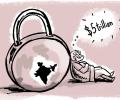
India's growth and success is guaranteed, he said propagating his idea of making the country self-reliant by cutting imports.

India's economic growth is now 'extremely fragile' and needs all the support that it can get, as private consumption and capital investment are yet to pick up, RBI Monetary Policy Committee (MPC) member Jayanth R Varma said on Friday. Varma further said out of the four engines of growth for the economy, exports and government spending supported the Indian economy through the pandemic, but other engines need to pick up the baton now. " I like to think in terms of the four engines of growth for the economy: exports, government spending, capital investment and private consumption. "...while exports cannot be the main driver of growth because of the global slowdown, government spending is necessarily limited by fiscal constraints," he told PTI.
The government's decision to pass on the rise in oil prices to consumers not only inflates their petrol and diesel bills, it also fuels concerns over a possible economic recession, analysts said.

"The theme of tomorrow's meeting is 'Economic Policy Reform, Road Ahead'. The prime minister will make opening remarks. There are 15 invitees who will make their presentations before the prime minister," a senior government official said.

The report said in the recent months policy makers as well as the private sector have made some efforts to improve productivity.
The Reserve Bank is unlikely to cut the benchmark interest rate in its forthcoming bi-monthly monetary policy review later in the week as retail inflation is still a cause of concern, and there is a possibility of the Middle East crisis deteriorating further, impacting crude oil and commodity prices, say experts.

While the economy seems to be on a firm growth path, the fight against inflation is not over yet. Shaktikanta Das seems to be in no hurry. After playing well through a five-year Test match, he doesn't want to get out hit wicket, observes Tamal Bandyopadhyay.

Bank of America Merrill Lynch on Monday trimmed India's economic growth estimates by 30 basis points to 7.1 per cent for the current fiscal, while global financial services giant Morgan Stanley downgraded its GDP growth forecast for the current fiscal to 7.3 per cent from the earlier 7.7 per cent.
Maintaining its growth forecast for the Indian economy at 7.6 per cent for 2011-12, financial services major Citigroup on Monday said higher farm output is expected to offset sluggishness in the industrial sector.
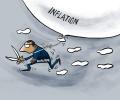
'If all goes well, we may well hit or even surpass the forecast growth rate.'

Emerging economies can expand at a "reasonable pace" in the next four to five years even if growth in developed nations is moderate, Planning Commission Deputy Chairman Montek Singh Ahluwalia said.

In Q1, India's GDP shrank by a staggering 24 per cent year-on-year amid the imposition of one of the most stringent global nationwide lockdowns.
Higher for longer' may be the narrative in the developed markets, but interest rates might not stay high for very long in India, with a section of the market expecting rate cuts to begin this year. The six-member Monetary Policy Committee of Reserve Bank of India (RBI) decided to keep interest rates unchanged at 6.5 per cent in the April review - after hiking the policy repo rate in six previous meetings. RBI Governor Shaktikanta Das emphasised that the pause was only for the April policy and that the central bank was ready to act if the situation demanded.

After navigating the turbulent pandemic waves, the recovering Indian economy is now sailing through unchartered waters of rising coronavirus cases, spiralling commodity prices and spiking inflation though the lighthouse of sustainable growth remains visible. As 2022 begins, a raft of developments, ranging from Budgetary announcements to continuation of stimulus measures to monetary policy, will set the tone for the domestic economy, which is projected to grow more than 9 per cent in the current fiscal ending March 2022. The country's continuing massive vaccination drive and 'precaution' doses starting for select categories of people this month will provide a firewall against any steep spike in coronavirus cases amid the emergence of the Omicron variant.

Markets this week would be guided by the ongoing quarterly earnings, macroeconomic data announcement and global trends, analysts said. The government will release industrial production data for June and inflation data for July this week. The RBI has revised its retail inflation forecast to 5.7 per cent, up from the earlier 5.1 per cent due to price pressure on account of supply constraints and high crude oil prices.
While the latest consensus still suggests growth will beat the rate of less than 5 per cent seen in the past two years, it does not reflect the stock market euphoria since Prime Minister Narendra Modi's historic election win two months ago.

In India, economic activity slowed substantially in 2019, with the deceleration most pronounced in the manufacturing and agriculture sectors, whereas government-related services sub-sectors received significant support from public spending, the Bank said.
December's figure was the seventh successive quarter of economic growth below 5 per cent.

Rajan had said that there was lack of clarity about the new method.

A month-long national lockdown to arrest the spread of COVID 2.0 could shave off 100-200 bps of GDP, leading to a 300 bps risk to annual growth, a brokerage report has flagged while expressing doubts over the ability of local lockdowns to control the pandemic. The second wave of the coronavirus inflection has caught the government off-guard with the daily cases jumping over 6.5 times in the past 30 days. With close to 3.53 lakh fresh daily infections, the country is the worst hit globally.

Goldman says the downgrade reflects the more difficult external funding conditions for Asia as markets increasingly anticipate Fed tapering and eventual exit from unconventional monetary policies.

S&P Global Ratings on Thursday said the Indian economy is projected to grow at 11 per cent in the current fiscal, but flagged the "substantial" impact of broader lockdowns on the economy. In its report on Asia-Pacific Financial Institutions, S&P said the control of COVID-19 remains a key risk for the economy. New infections have spiked in recent weeks and the country is in the middle of a second pandemic wave.

The overall FPI inflows should move into the range of $15-20 billion in fiscal 2017 with equity dominating with $10-15 billion and debt with $5 billion
